
Planning for Mastery: Competency-Based Planning for Instruction
A competency-based planning framework for accessible, standards-aligned learning.
This project demonstrates how competency-based learning can be used to design instruction that moves beyond seat time and toward demonstrated mastery. The original education version integrates CBL, UDL, WIDA, and CCSS to support equitable access, learner variability, and authentic assessment. A companion business adaptation shows how the same framework can be translated into workplace learning through performance outcomes, practice, feedback, and demonstration of competence.
Audience
Classroom teachers, instructional coaches, curriculum designers, and school leaders seeking to design standards-aligned, competency-based learning experiences. This framework is particularly relevant for educators integrating Universal Design for Learning (UDL), WIDA language development standards, and Common Core State Standards (CCSS) to support learner variability, accessibility, and equitable pathways to mastery.
Context
Teachers are often expected to design instruction that meets diverse learner needs while ensuring all students demonstrate mastery of required standards. Without clearly defined learning targets and success criteria, instruction can become activity-driven rather than mastery-driven.
Competency-based learning shifts the focus from what learners have completed to what learners can demonstrate. Rather than measuring progress through seat time or task completion, competency-based approaches emphasize mastery, application of learning, and authentic evidence of understanding.
At the same time, effective competency-based instruction must account for learner variability. Students bring different backgrounds, strengths, language proficiencies, interests, and support needs to the learning process. Integrating Universal Design for Learning (UDL), WIDA language development standards, and Common Core State Standards (CCSS) helps ensure that all learners have equitable access to instruction and multiple pathways for demonstrating mastery.
Planning for Mastery was developed to help educators align these frameworks into a cohesive planning process that supports rigorous, accessible, and learner-centered instruction.
Goal
To demonstrate how competency-based planning can be used to clarify learning expectations, align instruction to standards, and support differentiated pathways toward mastery.
The framework helps educators design competency-based learning experiences aligned to Universal Design for Learning (UDL), WIDA language development standards, and Common Core State Standards (CCSS), while providing equitable opportunities for all learners to demonstrate mastery.
Instructional Intent
This framework was designed to help educators shift from activity-driven instruction to mastery-driven learning. Rather than focusing on the completion of tasks, the planning process begins with clearly defined competencies, success criteria, and evidence of learning.
Instructional decisions are guided by the principles of competency-based learning, Universal Design for Learning (UDL), WIDA language development standards, and standards-based design. Together, these frameworks support learner variability, accessibility, meaningful assessment, and multiple pathways toward mastery.
The intent is not simply to improve lesson planning, but to create learning experiences that provide all students with equitable opportunities to demonstrate understanding and apply learning in authentic contexts.
Instructional Design Approach
This project was developed using the ADDIE instructional design framework. During the analysis phase, instructional standards, learner variability, language development needs, and desired mastery outcomes were identified. The design phase focused on aligning competencies, learning objectives, instructional activities, and assessment evidence within a competency-based learning model.
Development emphasized the integration of Universal Design for Learning (UDL), WIDA language development standards, and Common Core State Standards (CCSS) to support accessibility, differentiation, and equitable participation. Evaluation focused on the extent to which learners could demonstrate mastery through authentic evidence of learning rather than completion of instructional tasks alone.
The resulting framework provides educators with a structured process for planning rigorous, standards-aligned instruction that supports multiple pathways toward mastery.
Learning Design
This project models a competency-based instructional planning framework that emphasizes clear learning targets, aligned instructional experiences, and defined criteria for mastery. The design process begins by identifying what learners must know and be able to do, then aligning instruction, assessment, and supports to those outcomes.
Rather than organizing instruction around activities alone, learning experiences are intentionally sequenced to support skill development, guided practice, feedback, and authentic demonstration of learning. Mastery is measured through evidence of performance and application rather than completion of tasks or time spent in instruction.
The framework incorporates Universal Design for Learning (UDL), WIDA language development standards, and Common Core State Standards (CCSS) to ensure that learning experiences are accessible, standards-aligned, and responsive to learner variability.
Key design elements include:
• Standards-aligned learning targets written in student-friendly language
• Competencies and success criteria that clearly define mastery
• Instructional activities mapped directly to target skills and outcomes
• Opportunities for differentiated practice, scaffolding, and formative assessment
• Multiple pathways for learners to access content and demonstrate understanding
• Authentic evidence of learning aligned to mastery expectations
Planning for Mastery Framework
A visual overview of the competency-based planning model.

Project Artifacts
The Planning for Mastery framework is supported by a collection of planning and assessment tools designed to help educators translate competency-based learning principles into classroom practice. These artifacts demonstrate how learning targets, instructional supports, and mastery criteria can be aligned to create accessible and standards-based learning experiences.

Interactive presentation introducing the Planning for Mastery framework, including competency-based learning, UDL integration, WIDA supports, standards alignment, and mastery-focused instructional design.
Opens in a new tab. Interactive HTML5 module hosted in Google Cloud.
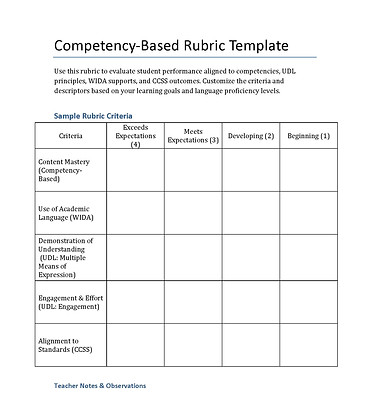
Sample mastery rubric demonstrating how competency-based assessment can be aligned to UDL principles, WIDA language supports, and standards-based outcomes.
Competency-Based Unit Design Template
This planning template was developed to help educators translate competency-based learning principles into instructional practice. The template aligns learning targets, standards, instructional supports, assessment evidence, and mastery criteria within a single planning framework. UDL considerations, WIDA language supports, and standards-based outcomes are embedded throughout the planning process to support equitable access and learner success.
Interactive Competency-Based Planning Template
view only
Framework in Practice: Winter Wonders
Winter Wonders demonstrates the Planning for Mastery framework applied to a standards-aligned K–3 literacy unit. The project integrates competency-based learning, Universal Design for Learning (UDL), WIDA language development standards, and Common Core State Standards (CCSS) within an authentic instructional context.
The unit was designed to provide multiple pathways for engagement, representation, and expression while supporting language development and standards mastery. Learning activities, assessments, and instructional supports were intentionally aligned to competency-based outcomes, allowing learners to demonstrate understanding through meaningful application of knowledge and skills.
This project illustrates how the Planning for Mastery framework can move from instructional theory to classroom implementation.

Winter Wonders Unit
See how the framework was applied in a standards-aligned literacy unit designed to support multilingual learners through integrated language and content instruction.
Note: Artifacts shown are representative examples created for portfolio demonstration. Any student references or scenarios are fictional.