

Designing for Mastery
An Integrated Professional Learning Solution
Project Overview
Designing for Mastery is an integrated professional learning solution designed to help educators make intentional, learner-centered instructional decisions. The project brings together professional learning, planning tools, performance supports, and classroom application to connect competencies, standards, UDL, WIDA, assessment, and instructional strategies within one coherent planning process.

Understand
What instructional decisions must teachers make before they begin planning?
Educators make critical instructional decisions before learning begins—from defining competencies and aligning standards to selecting learner supports, assessments, and instructional strategies. Because these decisions are often addressed independently, it can be difficult to create coherent, learner-centered instruction. I identified the need for a planning process that brings these decisions together into one integrated workflow.
Framework Principle
Evidence


Integrated Planning Template
The planning process begins by establishing the instructional context, including the learning goals, instructional focus, and the essential question that guide subsequent design decisions.
Strong instructional design begins by identifying the decisions that drive successful learning experiences.
Instructional Insight
Effective instructional planning connects competencies, standards, learner supports, assessment, and instruction into a coherent decision-making process.
Envision
What should educators be able to do after completing the planning process?
I envisioned a planning process that would help educators think like instructional designers. Rather than selecting activities first, teachers would define competencies, establish clear success criteria, align standards, anticipate learner variability, and intentionally design assessments and instructional supports. The planning process was designed to help educators make purposeful instructional decisions by defining success before selecting instructional strategies, learner supports, and assessments.
Framework Principle
Evidence
The planning process begins by establishing the instructional context, including learning goals, instructional focus, and essential questions. These decisions create the foundation for every instructional choice that follows.

The Competency Progression Framework defines what successful performance looks like before instruction is designed. Establishing clear success criteria first ensures that instructional decisions remain aligned to the intended competency throughout the planning process.

Effective design begins by defining what successful performance looks like before planning instruction.
Insstructional Insight
Establishing clear success criteria first creates a foundation for aligning standards, instructional supports, assessments, and instructional strategies.
Design
How did I design a system that supports intentional instructional planning?
I designed an integrated professional learning solution that supports educators from initial planning through classroom implementation. Rather than relying on a single planning document, the solution combines professional learning, planning tools, performance supports, and assessment resources into one cohesive instructional system. Each resource supports a different stage of the instructional planning process while working together as one integrated instructional system.
Framework Principle

Effective instructional systems combine learning experiences, planning tools, and performance supports to guide successful implementation.
Integrated Professional Learning Solution
The instructional planning system includes professional learning materials, planning tools, and performance supports that guide educators from understanding the planning process to implementing it independently. Each resource was intentionally designed to support a different stage of instructional planning.
Professional Learning Presentation
Integrated Planning Framework
Participant Guide


Competency Progression Framework
Performance Assessment Rubric
Classroom Implementation
Each resource supports a different stage of instructional planning while working together as one integrated instructional system. Together, these tools help educators move from understanding instructional frameworks to applying them confidently in classroom practice.
Instructional Insight
The strongest instructional systems support educators from understanding new ideas to applying them independently.
Engage
How was the professional learning experience designed to build instructional decision-making?
I designed the professional learning experience around modeling, guided practice, and application. Rather than introducing instructional frameworks independently, educators work through authentic planning decisions, gradually connecting competencies, standards, instructional supports, assessment, and learning experiences into one coherent planning process. The learning experience is designed to build confidence while preparing educators to apply the process independently.
Framework Principle
Learning is strengthened through modeling, guided practice, and authentic application.
Evidence


Professional Learning Experience
This sequence illustrates how the workshop models instructional decision-making through guided examples and collaborative application. Rather than presenting the frameworks independently, each activity builds on the previous one, helping educators connect competencies, standards, instructional supports, and assessment into one coherent planning process.
Instructional Insight:
Guided practice helps learners move from understanding a framework to making informed decisions independently.
Assess
How would educators demonstrate mastery of the planning process?
The planning process was designed to help educators independently apply the framework when developing new instructional experiences. Success was demonstrated through the ability to make intentional instructional decisions by connecting competencies, standards, learner supports, assessment, and instruction within a coherent plan.
Framework Principle
Assessment should measure the learner’s ability to apply knowledge and skills in an authentic context.
Evidence
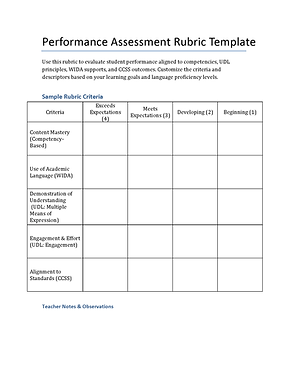
Performance Assessment Rubric
The rubric evaluates educators’ ability to apply the integrated planning process independently. Criteria focus on alignment among learning goals, standards, learner supports, assessment, and instructional decisions.
Instructional Insight
Mastery is demonstrated through independent application, not simply understanding the planning process.
Reflect & Refine
What would I learn from implementation and use to improve the system?
The planning system was designed as an iterative process rather than a finished product. Applying the process to an authentic instructional context provided an opportunity to examine how well the components worked together and identify areas that might need additional guidance or support. Future implementation with educators would provide additional evidence through completed planning tools, performance assessments, reflections, and classroom application.
Framework Principle
Effective learning solutions evolve through evidence, reflection, and continuous refinement.
Evidence

Classroom Application: Winter Wonders
Winter Wonders demonstrates how the integrated planning process can be translated into classroom instruction by aligning academic goals, language development, learner supports, assessment, and learning experiences within a cohesive unit.
Winter Wonders: Integrated PreK Lesson Plan
Winter, Ice & Snow • One-Week Thematic Unit
Explore Winter Wonders
Supporting Instructional Resources
Rhyming Routine Cards
Instructional Insight
Applying a design process reveals opportunities for refinement that may not be visible during planning alone.