My Learner-Centered Design Framework
Designing Learning That Begins with the Learner
Meaningful learning begins by understanding the learner.
Throughout my career—from early childhood and special education to curriculum development and digital learning—
I discovered that successful learning experiences share one thing in common:
They begin with the learner, not the content.
The Story Behind the Framework
Early in my career, I focused on creating engaging lessons and instructional materials. As my work expanded into curriculum development and instructional design, I found myself asking deeper questions before designing instruction.
-
Who are the learners?
-
What challenges are they trying to overcome?
-
What knowledge, skills, or support do they need?
-
How will I know they have truly succeeded?
Those questions became the foundation of every learning experience I designed.
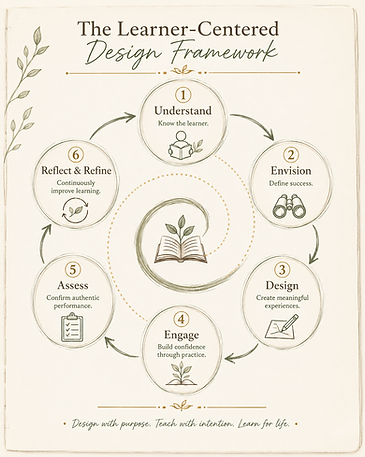
Understand

Understanding learners is the foundation of every successful learning experience. Before identifying solutions, I explore learners' needs, goals, prior knowledge, motivations, and the context in which learning will occur.
Framework Principle
Design begins by understanding people—not simply the content they need to learn.
Envision
Clear outcomes provide direction for every design decision. By defining meaningful success first, instruction remains focused on authentic performance rather than task completion.
Framework Principle
Meaningful learning begins with a clear vision of successful performance.
Design
Learning experiences should intentionally connect objectives, instruction, practice, feedback, and support. Every activity serves a purpose and helps learners move toward meaningful performance.
Framework Principle
Purposeful design creates meaningful learning experiences.
Engage
Clear outcomes provide direction for every design decision. By defining meaningful success first, instruction remains focused on authentic performance rather than task completion.
Framework Principle

Learners build understanding through meaningful practice, feedback, and active participation.
Assess
Assessment provides evidence of learning while informing instructional decisions. Authentic assessment focuses on what learners can do, not simply what they know.
Framework Principle
Measure meaningful performance rather than task completion.
Reflect & Refine
Assessment provides evidence of learning while informing instructional decisions. Authentic assessment focuses on what learners can do, not simply what they know.
Framework Principle
Evidence and reflection guide continuous improvement in learning design.
Framework in Practice
The projects that follow demonstrate the Learner-Centered Design Framework across diverse audiences, learning environments, and instructional challenges.
Throughout each case study, you'll find:
Framework Principles that highlight the thinking behind key design decisions and illustrate how the framework guides my work as a learning experience designer.
